
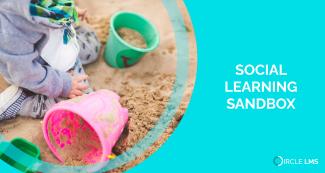
“After observing children in a native [Indian] school, seated on the ground, and writing in the sand, he [Andrew Bell] set a boy, John Frisken, to teach the alphabet on the same principle.”
Thus was born in 1787 the “Madras” or monitorial system of teaching, wherein students teach. The system, developed by Andrew Bell and Joseph Lancaster, was quickly and broadly adopted as it solved a pressing need for teaching many students with few teachers.
Today, we have a similar problem, an epic skills gap. The good news is student teachers need not write in the sand. The bad news is we have organizational inertia. But if you have an LRS or an LMS with LRS capabilities, you can create your own social learning sandbox on the cheap.
In future posts, we will examine the benefits of this approach but today we will look at how to initiate it.
Start with the corporate mission, defined by Kotter and Heskett as “a set of values, beliefs, and norms of behavior shared by its (a firm’s) members that influences employee preferences and behaviors toward strategic intent.”
Use the corporate mission as a starting point upon which learners construct an understanding of how the work they perform fits into the overall. If your organization doesn’t officially have one, invite participants to create one. Details of how to do this in future posts.
The next level is to consider the key elements of business success. There are a number of ways to look at this but here is a good list penned by Buck Lawrimore:
- Strategic Focus (Leadership, Management, Planning)
- People (Personnel, Staff, Learning, Development)
- Operations (Processes, Work)
- Marketing (Customer Relations, Sales, Responsiveness)
- Finances (Assets, Facilities, Equipment)
These categories (or the ones you choose) help employees see the big operational picture and where they sit within it. Next is to drill into the department, operating group, and ultimately, the individual and their tasks. By constructing an understanding of their role from the basic, corporate mission level, employees often gain a greater sense of respect for themselves and their work. They more clearly see how their work fits with others.
What does this have to do with the social learning sandbox? Answer: it IS the sandbox. How does this learning path happen? More next week….